Uncertainty is part of life.
Resilience is the ability to handle it—in fact, to lean into it from a place of strength.
Since uncertainty isn't going away in our lifetime—or our children's—it's time we built some extra resilience.
Let me tell you a story. If there is ONE story that is foundational to everything that came afterwards for me, this is it.
When I was 17, I boarded a plane in Paris, destination Los Angeles. Alone.
Two weeks prior, I had told my parents that I would not go to university in Paris, that I had bought a plane ticket to LA behind their backs, and that whatever happened next, I would find out by flying to California on my own.
Here is the key part of the story: The whole 12 hours from Paris to Los Angeles, I remember having a singular thought, "I wish this plane would turn around."
I will be forever grateful that it didn't.
What's my point?
That there is a time and a place to sign up for volatility and uncertainty. That's where the magic happens… Where generational changes are possible.
But you have to pick your spots, and you need to be able to put up with things potentially going badly.
And, remembering that CDG-LAX flight like it was yesterday, I can tell you one thing for sure:
While you're going through it, it likely will feel like you made the worst decision possible. And there is no way to see the other side clearly while you're mid-flight.
But if you're lucky, one day, you get the unequivocal affirmation that it was all worth it. In my case, I got this to prove it.

Speaking of picking your spots and positioning for resilience…
Let's start with a reasonably complete account of what's happened in markets since the start of 2023.
You will recall that 2022 was an awful, no-good, bad-all-around kind of year: Inflation was still raging, the Fed was taking interest rates to shocking levels to shove the genie back in the bottle, and nearly every asset class printed losses as a result.
Then, ChatGPT happened.
And a new bull market was born.
Look at the graph below, which starts in January 2023.
Until the start of 2025, U.S. stocks dominated the charts, and the U.S. dollar held strong and steady.

Then, right around the time we learned the new meaning of “Liberation Day,” something changed.
U.S. stocks started decelerating relative to the rest of the world. Developed (and Emerging Market) stocks started closing the performance gap relative to the U.S. So far in 2026, Developed equities have risen while the S&P has largely stalled.
Adding insult to injury, the bonds of Emerging Markets (those that borrow in their own currencies) started doing very well indeed. Emerging Markets Local Bonds are now up 35-40% since 2023, while a broad U.S. bond index is up 15%, and long-dated Treasuries are down just a touch.
In the meantime, the U.S. dollar has spent the better part of 2025 and 2026 so far drifting down (approximately down 7% against a basket of major currencies), and gold—well, you know what’s happened with gold, assuming you have access to the internet...
Now, always remember that a compelling narrative doth not statistical significance make. In fact, my friends with Ph.D.s from the University of Chicago have a saying: "the plural of anecdote is not data."
So the best we can do is keep score for a while, to see if what we’re witnessing is indeed a lasting "regime change" (in the statistical sense, I mean, naturally) or a short-lived aberration.
Here is a scorecard for 2026 so far: actual performance vs. the statistical distribution of potential outcomes (based on 2023–2025 data).
The S&P 500 isn't exactly shining but it’s still tracking the "central tendency." Nothing broken there (yet).
The Nasdaq is flat so far and looking a little wobbly relative to the explosive growth of the last three years.
Developed and Emerging Markets are both largely tracking along the plus-1 standard deviation line.
Bitcoin—just because I couldn't help myself—is down near the minus-2 standard deviation line, which for highly volatile BTC means roughly -20%. Eech…


As they say, the night is young and so are we (at least as far as 2026 is concerned). Let's not read too much into this. Certainty is poison, in life and in investing.
But wouldn't it be something if the recent past didn't repeat over and over again?
Just in case, this may be reason enough to build a little extra resilience indeed.
Now, let’s switch back to where we started.
What do we teach our children about their own "12-hour solo flights" ahead?
They will face moments of doubt and fear, and they will want to turn back.
For better or worse, money will likely act as a magnifying agent, distorting reality and perception.
To that end, I've put together a resource page that brings together conversations, articles, and frameworks for families navigating these questions.
It's called Preparing the Next Generation, and it starts with something my friend Joline Godfrey told me: your kids are ready to talk about money about ten years before you are.
Ten years. That's a lot of missed conversations. A lot of silence that gets filled with anxiety instead of understanding.
The page includes my conversations with Joline about raising financially capable kids and her framework called F.I.S.H.—Financial, Intellectual, Social, and Human capital. You'll also find writing on when and how to start these conversations.
If you're managing substantial wealth and wondering how to help your kids develop their own healthy relationship with it, I hope you'll start there. And I really hope it helps.
If we do this well, I believe we can help our kids—all of our kids—to lean into life and lean into the uncertainty that comes with it. To view it all as a gift, an adventure to be cherished and one they feel prepared for.

One last thing…
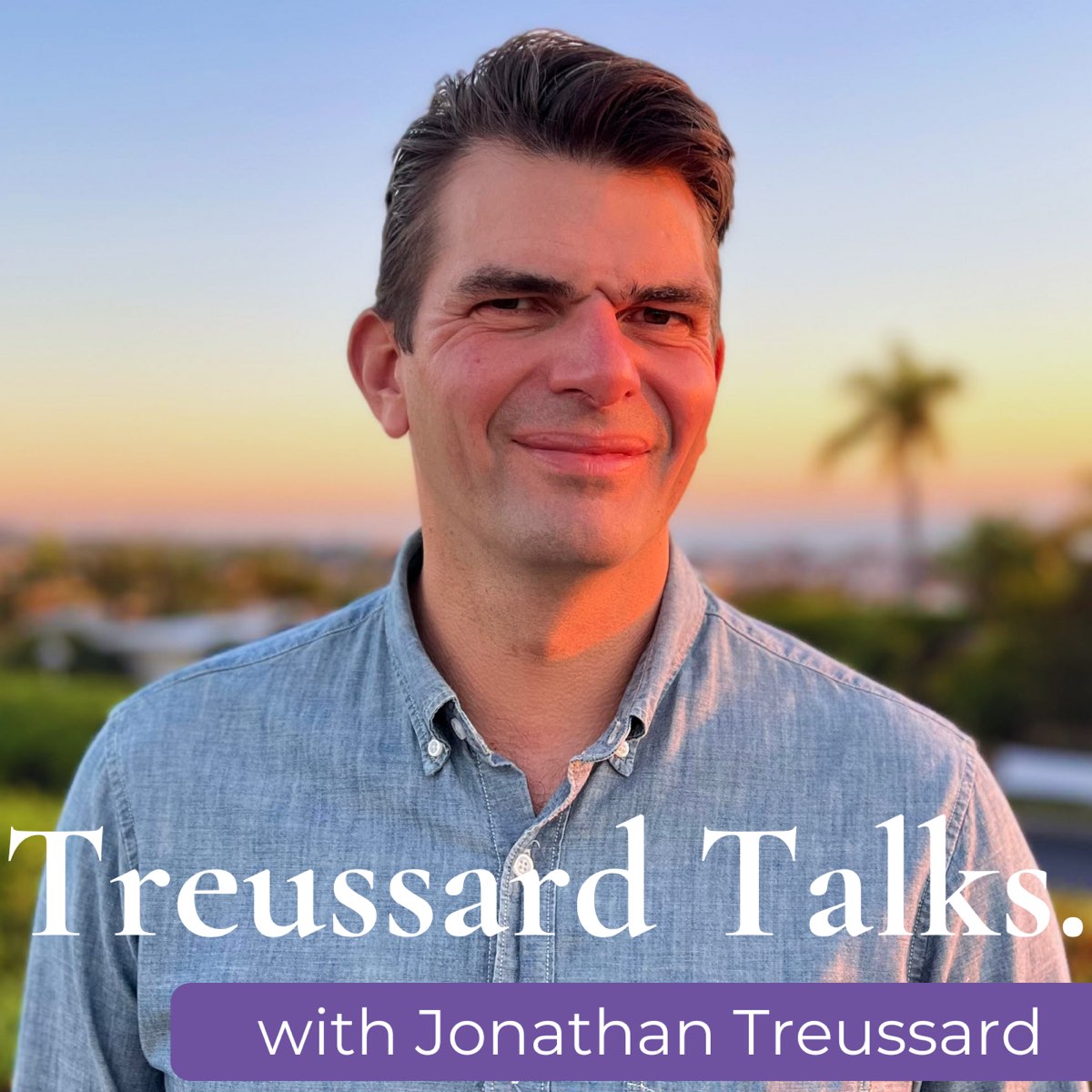
My conversation with Vineer Bhansali on TREUSSARD TALKS.
Vineer was trained as a physicist at Caltech under Richard Feynman.
Option-pricing giant Fischer Black hired him at Goldman ("knows math, not much finance" were Black's notes from the job interview).
His career at PIMCO where he became an MD started with him creating analytics for Bill Gross' "big book of bonds."
He is thoughtful, determined, and relentless (you need to be, to be an ultramarathon runner).
When you listen to our conversation, you'll hear why his favorite word is "resilience" without hesitation—and why his least favorite word is "greed."
Thirty-plus years of navigating markets and competing in ultra-marathons (Death Valley in the dead of summer, anyone?) taught him a singular lesson: the number one job is don't die.
Don't get forced out of the game.
He says that greed—not risk—is what often destroys wealth.
The desire to maximize returns at all costs leads investors to forget that staying in the game is what makes long-term compounding possible in the first place.
When you're forced to sell in a crisis, or when you panic because you didn't prepare for volatility, you lose your most valuable asset: being in the market on your own terms and on your own timetable.
Resilience means managing portfolios so they can withstand regime changes, correlation breakdowns, and extreme events.
It means accepting that markets don't move in straight lines, that diversification alone may not protect you when everything starts to move together (like 2022, or Liberation Day 2025), and that sometimes explicit, contractual protection makes sense—not just the hope that things will average out.
Vineer believes we're exiting a 30-year period of falling rates, low volatility, and credible central banking.
The question isn't how to avoid turbulences. Realistically, you probably can’t.
And what would the fun in that anyway? That’s what the nearly 30 years that have followed my 12-hour flight over have taught me.
Uncertainty is life, not deviation from it.
And so, it’s high time we learn that lesson and pass it on to our kids.
Don’t fear volatility. Understand it.
Don’t think you can control outcomes. You can’t, but you can control how you react along the way.
And develop a clear sense for what healthy discomfort feels like. So that when you go through it, you know it like an old friend and hang tight.
That’s where the magic happens.
If you want to go deeper:
Preparing the Next Generation resource page
TREUSSARD TALKS podcast with Vineer Bhansali:
Connect on LinkedIn
Jonathan
Disclaimer: All content here, including but not limited to charts and other media, is for educational purposes only and does not constitute financial advice. Treussard Capital Management LLC is a registered investment adviser. All investments involve risk and loss of principal is possible.
Full disclaimers: https://www.treussard.com/disclosures-and-disclaimers.